Toyota has supplied an unusually detailed first look at the 2027 Highlander, but the announcement is not a finished buyer’s guide. It identifies four battery-and-drivetrain configurations, two grades, dimensions, equipment, and several manufacturer estimates. It does not include pricing or final EPA range ratings.
The question is narrower than “Is this a 320-mile SUV?” Buyers need to know which configuration carries that estimate, what equipment comes with it, and which missing numbers could still change the value calculation.
The lineup is electric, so configuration matters
The Toyota launch record describes a battery-electric powertrain as standard for the 2027 Highlander. It calls the vehicle Toyota’s first three-row battery-electric model for the U.S. market.
XLE is the flexible grade. It can be front-wheel drive or all-wheel drive, and its all-wheel-drive version can use either the 77.0-kWh or 95.8-kWh battery. Limited is all-wheel drive with the 95.8-kWh battery.
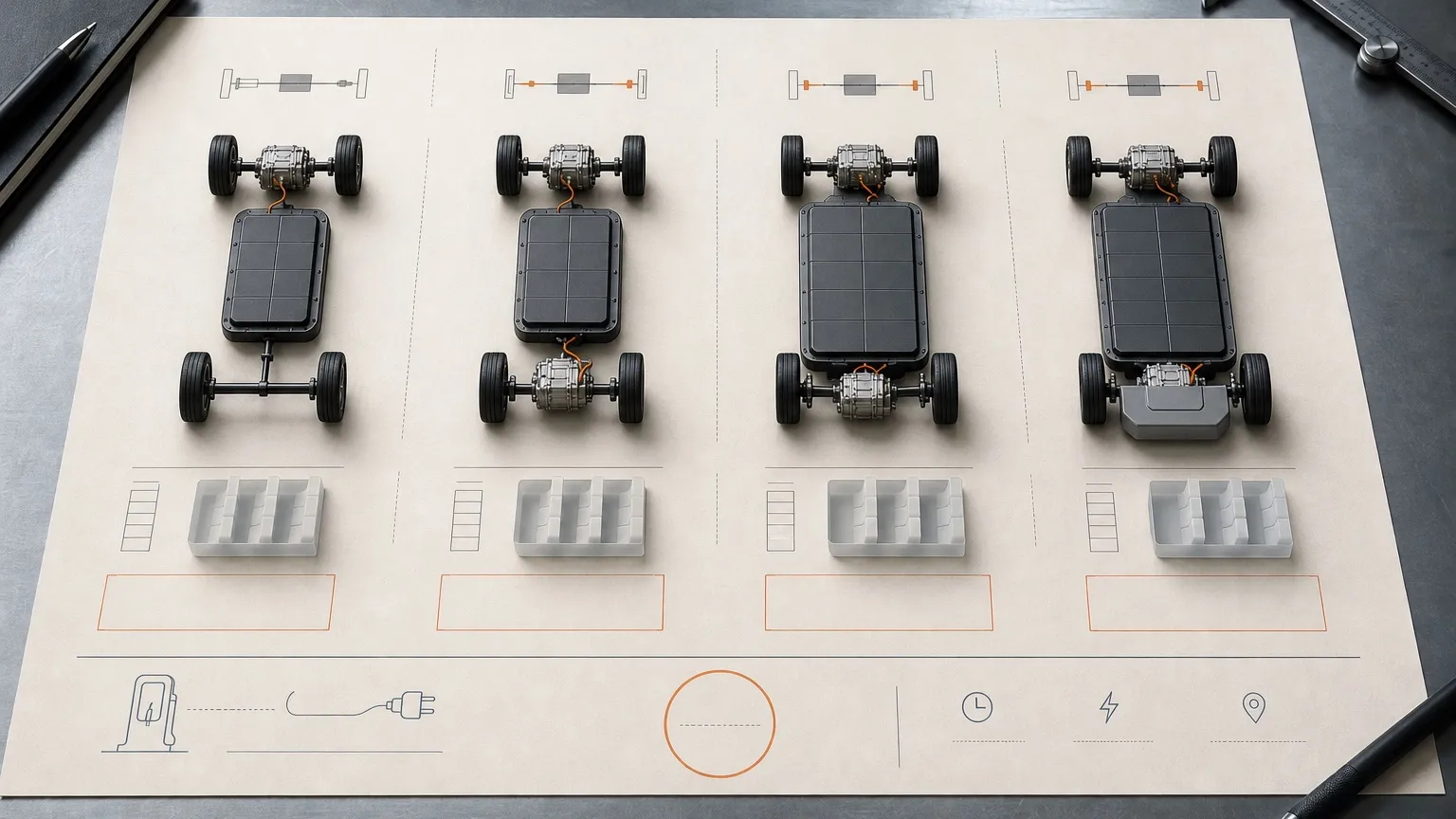
That produces four announced combinations:
- XLE front-wheel drive with the 77.0-kWh battery
- XLE all-wheel drive with the 77.0-kWh battery
- XLE all-wheel drive with the 95.8-kWh battery
- Limited all-wheel drive with the 95.8-kWh battery
The smaller-battery front-wheel-drive XLE is rated by Toyota at 221 system horsepower. Toyota lists 338 system horsepower for both all-wheel-drive grades. Those are company specifications, not independent performance measurements.
Scope and limits
The four announced configurations
| Configuration | Toyota has announced | Still not established |
|---|---|---|
| XLE FWD, 77.0 kWh | 221 hp and a manufacturer-estimated 287 miles of total range. | MSRP, final EPA range, peak DC power, and configuration-specific charging time. |
| XLE AWD, 77.0 kWh | 338 hp and a manufacturer-estimated 270 miles of total range. | MSRP, final EPA range, peak DC power, and configuration-specific charging time. |
| XLE AWD, 95.8 kWh | 338 hp and a manufacturer-estimated 320 miles of total range. | MSRP, final EPA range, peak DC power, and configuration-specific charging time. |
| Limited AWD, 95.8 kWh | 338 hp and a manufacturer-estimated 320 miles of total range. | MSRP, final EPA range, peak DC power, and configuration-specific charging time. |
The range headline needs its configuration label
Toyota’s highest estimate is 320 miles, but that number belongs only to the two all-wheel-drive configurations with the 95.8-kWh battery. The 77.0-kWh XLE is estimated at 287 miles with front-wheel drive and 270 miles with all-wheel drive.
Each figure is explicitly manufacturer-estimated. Toyota warns that actual range varies with weather, driving style, and other factors. The page does not present final EPA ratings.
Keep that limitation in every comparison. “Up to 320 miles” is accurate only as the top of Toyota’s estimated range, not as a promise for every Highlander.
Charging has a framework, not a complete curve
Toyota says every 2027 Highlander will include a North American Charging System port, an 11-kW onboard AC charger, and a dual-voltage 120/240-volt cable. Plug & Charge and battery preconditioning are also announced, although some automatic and connected functions require active trials or subscriptions.
For DC charging, Toyota says the battery can move from 10 to 80 percent in around 30 minutes under ideal conditions. The announcement does not disclose a peak DC charge rate, a sustained charging curve, or separate times for the two battery capacities.
Those omissions matter. A single 10-to-80-percent estimate is useful for trip planning, but it does not establish how quickly the vehicle adds miles at different states of charge or temperatures.
The three-row utility is more concrete
The Highlander seats up to seven with the available bench seat. Toyota says second-row captain’s chairs are standard and limits the bench option to XLE all-wheel-drive models.
The company lists 15.9 cubic feet of cargo volume with the third row in use and 45.6 cubic feet with it folded. Overall length is 198.8 inches, width is 78.3 inches, height is 67.3 inches, and wheelbase is 120.1 inches.
Vehicle-to-load capability is another confirmed feature, but it comes with an important boundary: bidirectional accessories must be purchased. Toyota says more details about those capabilities and accessories will come later.
Price is the largest unanswered comparison input
Toyota says sales are expected to start in late 2026 and continue into early 2027. It has not published MSRP or said whether all four configurations will arrive together.
Without price, the announced range and equipment cannot answer whether the larger battery is a good value, how much Limited costs over XLE, or whether the front-wheel-drive version is the lower-cost long-range choice it appears to be on paper.
The launch record also leaves final EPA range, peak DC charging power, trim-by-trim option pricing, and the price of required vehicle-to-load accessories unresolved.
How it developed
What is known now, and what comes later
Vehicle and configurations announced
Toyota described the electric-only lineup, batteries, drivetrains, equipment, estimates, and expected sales window.
Launch record updated
The same official page records a March 30 update; its current specification table remains the source used here.
MSRP still pending
Toyota says pricing will be announced closer to the on-sale date.
Sales expected in late 2026
Toyota says sales should begin in late 2026 and continue into early 2027; exact configuration timing is not stated.
What to watch next
The next useful Toyota update is not another styling image. It is a configuration-level price and specification sheet that joins MSRP, final range, charging performance, standard equipment, and availability.
For now, Toyota has mapped four electric Highlanders and attached meaningful estimates to each. The largest buyer questions remain open: price, final ratings, and real configuration timing.